The Seven
Chairs
Philosophy
Every meeting has a cost. Most meetings cost too much. This toolkit helps you calculate the true price of attendance and decide who actually needs to be in the room.
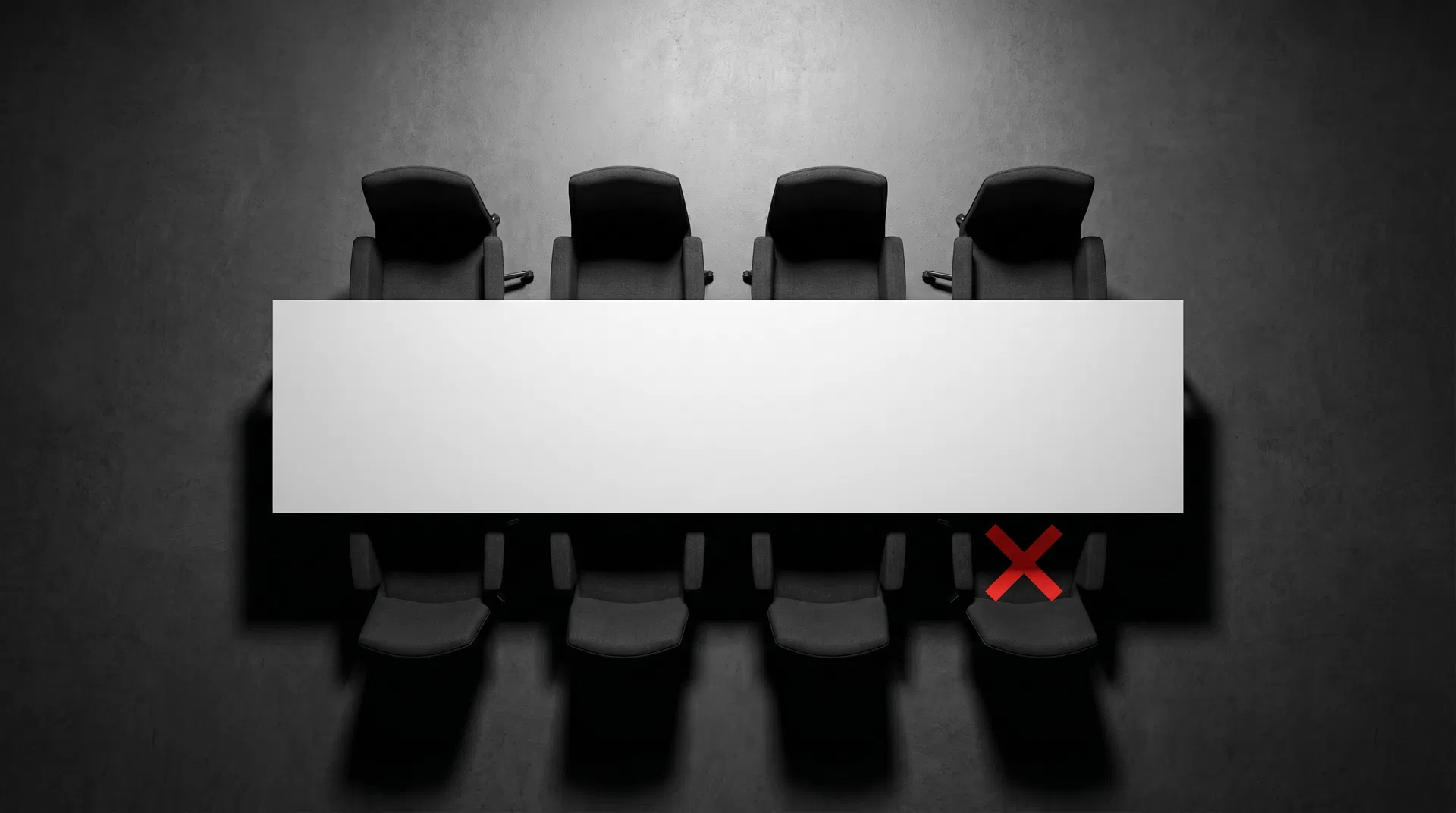
One chair fewer than the number of people invited.
Forces punctuality. Challenges necessity. Respects time.
Why the Seven Chairs Rule Works
The Seven Chairs Philosophy is a deliberate constraint. By providing one fewer chair than the number of people invited, you create two powerful psychological effects: punctuality and self-selection.
Effect 1: Punctuality
When there are not enough chairs, people arrive on time to secure a seat. Late arrivals must stand — or realize they may not need to be there at all. The physical constraint enforces a cultural norm.
Effect 2: Self-Selection
Invitees who question whether they truly need to attend will decline. This is the desired outcome. The missing chair is a filter, not a punishment. It forces every attendee to justify their presence.
The Pharma Construction Context
On a pharmaceutical manufacturing construction project, meetings involve PM, A&E, CM, QA, CQV, EHS, Regulatory, and Contractor teams — often simultaneously. The cost of unnecessary attendance is measured in thousands of dollars per meeting.
The Three-Tier Attendance Model
Active decision-makers. Their absence stops the meeting or renders its outcomes invalid. These are the people for whom the meeting exists. Examples: PM, CM, GC PM, A&E Lead on design coordination.
Adds value when present, but the meeting proceeds without them. They should attend if their schedule allows and the agenda is relevant. Examples: EHS Manager at a design review, Scheduler at a safety meeting.
Needs the outcome, not the conversation. Send them the meeting minutes. Their time is better spent elsewhere. Inviting them wastes their time and inflates meeting cost without adding value.
The Gwen Stefani Paradox
"Don't Speak" — No Doubt, 1996
Some meeting attendees are physically present but verbally absent. They sit through the entire meeting, contribute nothing to the discussion, make no decisions, and leave without having changed a single outcome. They were invited — so they showed up. But they Don't Speak.
There is No Doubt these people belong in the Inform After tier. They don't need the conversation — they need the conclusion. Send them the minutes and give their chair to someone who will use it.
How to identify a Gwen Stefani attendee
- —Attends every meeting but never speaks first
- —Responds only when directly asked a question
- —Has not changed a decision in the last 3 meetings
- —Could have received a summary email and been fine
- —Checks their phone or laptop throughout the meeting
- —Their absence would not delay or invalidate any decision
A 10-person meeting costs $1,000–$2,000 per hour.
When you include fully-loaded hourly rates for a typical pharma construction project team — PM, A&E, CM, QA, CQV, EHS, and Contractor leads — a single weekly 90-minute update meeting costs over $100,000 per year. The Seven Chairs framework is not a soft culture initiative. It is a financial discipline.
of a 10-person weekly
90-min update meeting
How to Assign Attendance Tiers
Can the meeting proceed without them?
Must: No — their input is required for decisions.
Nice: Yes — but their input improves outcomes.
Inform: Yes — they only need the result.
Do they have decision authority?
Must: Yes — they approve, sign off, or direct.
Nice: Partial — they advise but don't decide.
Inform: No — they receive and act on decisions.
Is their time better spent elsewhere?
Must: No — this meeting is their priority.
Nice: Possibly — they should self-select.
Inform: Yes — send them the minutes.
The Seven Chairs Rule Is More Critical in Virtual Meetings
In a physical meeting, over-inviting has a natural friction: the room fills up, the chairs run out, and people self-select. In a virtual meeting, the friction is zero. A calendar invite costs nothing to send. Joining a Teams call costs nothing to accept. This is precisely why the problem gets worse online.
The Seven Chairs rule still applies — but the chair is now the calendar slot. If you wouldn't give someone a physical seat at the table, don't give them a virtual one either.
Research shows ~30% of virtual attendees are multitasking at any given moment, reducing their effective participation to 70% of their hourly rate.
A camera-off attendee delivers approximately 15% of their physical meeting value. They are adjacent to the meeting, not in it.
Virtual meetings have a ~20% higher no-show rate than physical meetings. The cost is paid regardless — the invite was accepted.
Camera off = Don't Speak. Don't Speak = Read the Summary.
The Camera-Off Corollary is the virtual extension of the Gwen Stefani Paradox. In a physical meeting, the silent attendee at least receives non-verbal cues and body language. In a virtual meeting with camera off, they receive nothing and contribute nothing. They have self-selected out of the meeting — they just haven't admitted it yet. Move them to Inform After. Send them the summary. They will be relieved.
when camera is off
in a virtual session
Speak or Leave: The Final Gate Before the Invite Goes Out
Before you send a meeting invite, every Must Be There and Nice to Have attendee must be able to answer one question: What will you actively speak to in this meeting? Not observe. Not listen. Not follow along. Actively speak to.
If an attendee cannot name a specific agenda item they will own, they have self-selected into the Inform After tier. They just haven't realized it yet. The Speak or Leave checklist makes this explicit — before the calendar invite is sent, not after the meeting has already wasted everyone's time.
For each Must and Nice-to-Have attendee, the organizer enters the specific topic, decision, or update that person will actively present or speak to. Vague entries like 'attend' or 'listen' are not accepted.
The organizer explicitly confirms each attendee's agenda item. This creates accountability before the meeting — not during it. Unconfirmed roles are flagged and blocked from the invite.
Any attendee without a confirmed agenda item is automatically suggested for demotion to Inform After. The invite cannot be considered 'ready to send' until all remaining attendees are confirmed. This is the gate.
The confirmed agenda items for each Must Be There attendee form the basis of the meeting agenda. If the agenda is thin, the meeting is thin. If the meeting is thin, it should be an email.
If you can't name what you'll say, you don't need a chair.
The Speak or Leave gate is the final checkpoint before the Seven Chairs philosophy becomes a calendar invite. It forces the organizer to justify every seat at the table — not with job titles, not with org chart logic, but with a specific, declared contribution to the meeting's agenda. No contribution, no chair. No chair, no invite. No invite, no wasted hour.
a declared agenda item
before the invite is sent
Inform After Is Not a Passive Tier. It Requires Accountability.
Moving a role to Inform After only saves money if that person actually reads the meeting summary. An unread summary is worse than attendance — it creates a false record of communication while leaving the recipient uninformed. The organizer must close the loop.
The strategies below give the organizer concrete, low-friction mechanisms to verify that Inform After participants have consumed the summary within a defined window — without requiring them to attend the meeting itself.
When you move someone to Inform After, you take on a responsibility: the summary must be clear, complete, and delivered within the read window. If it isn't, the problem is the summary — not the tier assignment.
The meeting summary is distributed within a defined window after the meeting ends — typically 2–4 hours for same-day decisions, 24 hours for standard updates. The organizer sets the read deadline explicitly in the subject line: 'ACTION REQUIRED — Read by [Date/Time].' This transforms the summary from a passive document into a time-bound deliverable.
For high-stakes decisions, the organizer requests a one-line acknowledgment reply: 'Confirmed — read and understood.' This is not a full response; it is a receipt. For lower-stakes updates, email read receipts or a simple thumbs-up reaction in Teams/Slack serves the same function. The bar is low. The accountability is real.
The summary ends with one specific question directed at each Inform After recipient: 'Based on this update, does anything in your scope change?' This forces active reading — not passive receipt. A non-response within the read window is treated as a flag, not an assumption of agreement. The organizer follows up once before escalating.
At the opening of the next meeting in the series, the organizer spends 60 seconds confirming that Inform After recipients received and read the prior summary. This is not a quiz — it is a standing agenda item: 'Any questions from the last summary before we begin?' This creates a social contract around the Inform After tier and prevents summary fatigue.
If an Inform After participant consistently fails to acknowledge summaries within the read window, the organizer has two options: (a) move them back to Nice to Have for one cycle to re-establish the habit, or (b) escalate to their direct supervisor with a record of unacknowledged summaries. Chronic non-reading is a process failure, not a personal one — but it must be addressed.
Not all summaries carry the same urgency. Weekly progress updates: 24-hour read window. Design coordination decisions: 4-hour window. Safety or regulatory findings: 1-hour window, with phone confirmation for critical items. Commissioning hold points: immediate — summary is sent before the next shift begins. The organizer sets the window in the summary header, not in a separate message.
An unread summary is not communication. It is a liability.
In a pharma manufacturing construction project, an Inform After participant who does not read the summary is not just uninformed — they are a compliance risk. Decisions made in meetings have downstream consequences for validation, commissioning, and regulatory submissions. The read window is not a courtesy. It is a project control. Treat it as one.
Building a Realistic Agenda
An agenda is not a topic list — it is a contract between the organizer and the attendees. A realistic agenda assigns time, owner, and expected outcome to every item. Vague agendas produce vague meetings.
Every agenda item must answer three questions before the invite goes out:
A specific choice must be made and recorded. State the options and decision criteria in advance.
Status report from an owner. Limit to facts, schedule, cost, and blockers — no discussion unless a blocker requires it.
Open exchange to reach alignment. Must have a defined question and a time box. No open-ended 'any thoughts?'
Rapid status of prior action items. Owner confirms complete, in progress, or blocked. No re-discussion.
Structuring Valuable Meeting Minutes
Meeting minutes are not a transcript. They are the official record of what was decided, who is accountable, and what happens next. In a pharma construction context, minutes are a compliance and legal document — not a courtesy.
Minutes must be distributed within 24 hours of the meeting. Any action item not in the minutes does not officially exist. Any decision not recorded is subject to re-litigation at the next meeting.
Meeting AI Tools — Accuracy & Follow-Up
AI meeting tools do not replace the Seven Chairs discipline — they enforce it. When every word is transcribed, every action item is extracted, and every silent attendee is visible in the analytics, the cost of a poorly run meeting becomes undeniable. The following tools are evaluated for pharma construction project team use.
- Auto-transcription with speaker identification
- AskFred AI chat — query any past meeting
- Topic tracking with custom keyword filters
- Sentiment analysis per speaker
- Soundbite clipping for Inform After distribution
- CRM + Slack + Dropbox integrations
Custom topic filters can track RFI, submittal, and hold-point mentions automatically across all project meetings.
- Unlimited free transcription
- Auto-generated meeting summary
- Formatted copy-paste output (no cleanup)
- CRM sync and Slack distribution
- Keyword alerts on paid plan
- Short clip creation for key moments
Strong starting point for project teams not yet on a paid AI stack. Formatted output pastes directly into meeting minutes templates.
- AI Chat — ask questions about any meeting
- Account-wide search across all sessions
- Workspace channels for team alignment
- Action item assignment via @mention
- Audio/video file upload transcription
- Caution: struggles with technical terminology
Useful for retrieving specific decisions or commitments across a long project. Supplement with a technical glossary for pharma/construction terms.
- Cross-meeting AI search with advanced filters
- Scheduled AI reports (daily/weekly summaries)
- Team misalignment detection prompts
- Action item trend analysis
- HubSpot/Salesforce deal-stage filtering
- Lightweight on system resources
Scheduled reports can auto-generate weekly action item rollups across all project meetings — a direct replacement for manual meeting log maintenance.
- Captures audio from device — no bot joins the call
- Live notepad enhanced by transcript context
- Custom meeting templates
- Works with in-person and phone meetings
- Minimal, distraction-free interface
- HubSpot, Slack, Notion integrations
Ideal for in-person site meetings and walkthroughs where a bot cannot join. The device-capture approach works in construction trailers and field settings.
- SOC 2 Type II + Vanta-managed security
- OpenAI prohibited from training on your data
- Meeting brief + agenda collaboration
- Full meeting lifecycle management
- 50+ native integrations
- AI copilot for post-meeting Q&A
The strongest compliance posture of any tool in this category. Appropriate for pharma teams with data governance requirements around meeting content.
Before deploying any AI meeting tool on a pharma construction project, confirm the following with your data governance team:
- Data residency — where are transcripts stored?
- Retention policy — how long are recordings kept?
- AI training opt-out — is your data used to train models?
- Access controls — who can view meeting transcripts?
- Audit trail — are access logs available for inspection?
AI tool auto-sends agenda reminder 24 hrs prior. Speak or Leave items pre-loaded.
AI transcribes in real time. Organizer focuses on facilitation, not note-taking.
AI extracts action items, decisions, and speaker breakdown within minutes of close.
Full minutes to Must + Nice. Executive summary only to Inform After with read deadline.
Log Meeting Score. Flag silent attendees. Trigger Reassign Chronic Roles if pattern detected.
Most AI tools require a bot to join a video call. For physical meetings — the primary context of the Seven Chairs Philosophy — choose tools that capture device audio directly.
Construction site consideration: Verify that recording in the meeting space is permitted under local labor law and project confidentiality agreements before deploying any AI transcription tool.
Time Management Excellence
Twelve evidence-based strategies to transform meeting culture on your pharma construction project. Each suggestion includes the root problem, a concrete solution, step-by-step implementation, and measurable impact.
Implement the Quick Wins first.
The three Quick Win strategies — Seven Chairs, Gwen Stefani Audit, and No Meetings Before 10am — require no budget, no tools, and no approval. They can be in place by next Monday.
Calculate Your Meeting Waste
Select a meeting type, assign attendance tiers to each role, and see the true cost of your meeting — per session and annually. Apply the Seven Chairs rule to set the right number of chairs.
01 — Meeting Type
02 — Role Attendance Matrix
Before you send this invite: Every attendee in the Must Be There and Nice to Have tiers must have at least one agenda item they will actively speak to. If they cannot name one, they belong in Inform After — not in the room. Use the suggested prompts or type a custom item. Confirm each one before sending.
$115/hr loaded rate
$122/hr loaded rate
$122/hr loaded rate
$88/hr loaded rate
$81/hr loaded rate
$108/hr loaded rate
$95/hr loaded rate
$128/hr loaded rate
$119/hr loaded rate
$84/hr loaded rate
$78/hr loaded rate
$88/hr loaded rate
$74/hr loaded rate
$74/hr loaded rate
Do not send this invite until all attendees have a confirmed agenda item.
Every hour a contractor attends is a direct invoice line. These are real dollars spent.
Salaried employees cost the same whether in a meeting or doing productive work. The metric is time returned — hours reinvested into the project.
"Don't Speak" — No Doubt, 1996
If someone is in the room but never speaks, contributes nothing verbally, and leaves without having changed a single decision — there is No Doubt they can just read the meeting summary.
The Paradox: These attendees feel obligated to attend because they were invited. Meeting organizers feel obligated to invite them to avoid political friction. Neither party adds value. Both waste time. The chair they occupy belongs to someone who actually needs to be there.
Roles flagged as "Don't Speak" in this meeting:
Annual cost of silence
$31,824
Recommendation
Cost Visualization
Cost split by tier (per meeting)
- Must Be There
- Nice to Have
Per-meeting cost by role
Industry-Standard Hourly Rates Reference
US Market · 2025–2026 · Fully Loaded| Role | Category | Base $/hr | Loaded $/hr | Default Tier |
|---|---|---|---|---|
Owner's Project Manager PM | Owner / Client | $85 | $115 | Must |
Owner's Representative Owner Rep | Owner / Client | $90 | $122 | Must |
Facility Operations Lead Ops | Owner / Client | $70 | $95 | Nice |
A&E Lead Architect / Engineer A&E Lead | Architecture & Engineering | $95 | $128 | Must |
Process / Chemical Engineer Process Eng | Architecture & Engineering | $75 | $101 | Nice |
MEP Engineer MEP | Architecture & Engineering | $78 | $105 | Nice |
Design Manager Design Mgr | Architecture & Engineering | $88 | $119 | Must |
Construction Manager CM | Construction Management | $90 | $122 | Must |
Field Superintendent Supt | Construction Management | $65 | $88 | Must |
Project Scheduler Scheduler | Construction Management | $60 | $81 | Nice |
Cost Controls / Estimator Cost Ctrl | Construction Management | $62 | $84 | Nice |
General Contractor PM GC PM | General Contractor | $80 | $108 | Must |
GC Field Superintendent GC Supt | General Contractor | $58 | $78 | Nice |
Quality Assurance Manager QA Mgr | Quality & Validation | $85 | $115 | Nice |
CQV Lead (Commissioning, Qualification & Validation) CQV Lead | Quality & Validation | $82 | $111 | Nice |
Validation Engineer Val Eng | Quality & Validation | $65 | $88 | Inform |
Regulatory Affairs Specialist RA | Regulatory Affairs | $72 | $97 | Inform |
EHS Manager EHS | Environmental Health & Safety | $65 | $88 | Nice |
Mechanical Subcontractor Lead Mech Sub | Subcontractors | $55 | $74 | Nice |
Electrical Subcontractor Lead Elec Sub | Subcontractors | $55 | $74 | Nice |
